
We taught AI to say “I don’t know.”
Most AI systems are built to be capable first and accurate afterwards. Guardrails are layered on. Safety becomes something you configure, purchase separately and manage after the fact.
We built our Universal Agentic Control Layers the other way around. Responsible behaviour is not a setting. It is the ground state.
The AI that’s honest with you. Before it speaks.
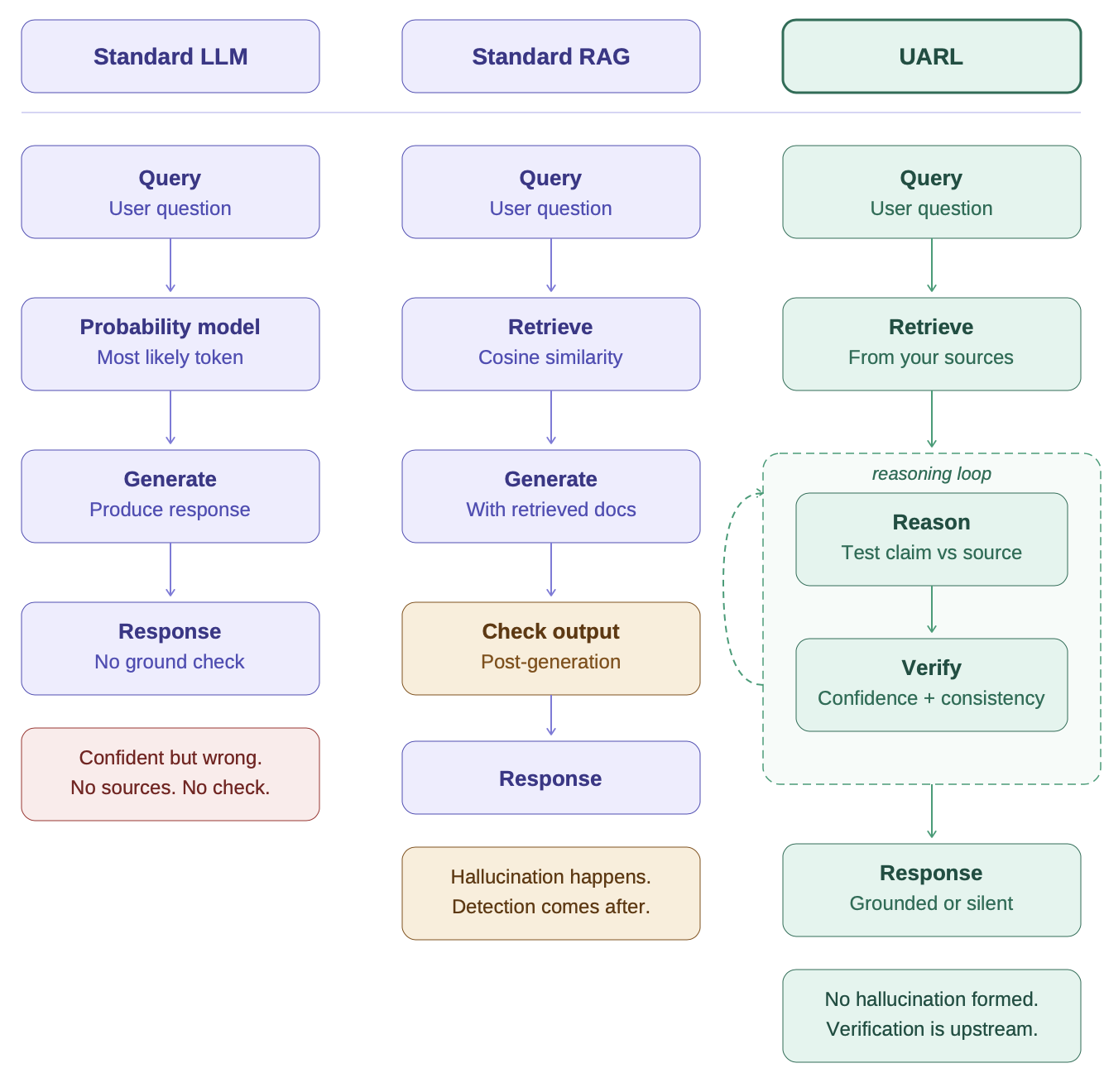
Responsible AI requires more than catching failures. It requires building a system that was never going to produce them. UACL monitors the integrity of the reasoning itself in real time, before any response is formed.
Confidence
How certain the model is about an answer.
Consistency
Whether that certainty holds across reasoning steps.
4 principles of hallucination prevention. One honest response.
Principle 1.
Measure Reasoning Honesty
We measure honesty where it begins: inside the reasoning itself, before a single word reaches you.
Principle 2.
Honest before delivering
We correct the answer before it leaves the system, because a warning attached to a wrong answer is not honest.
Principle 3.
Honest about knowledge gaps
When UACL cannot form a reliable answer, it says so, because an honest silence is more valuable than a confident fabrication.
Principle 4.
Honest about partial answers
We separate what we know from what we don’t, because a response that blends the two without telling you is not an answer, it’s a risk.
HALLUCINATION PREVENTION
UACL addresses the root cause of hallucinations not just the symptom, after the fact.
We are not building a better treatment.
We are working on preventing the condition that makes detection necessary in the first place.
Have a Question?
Why isn't hallucination detection enough for enterprise AI?
What actually causes AI hallucinations?
How do I reduce my enterprise AI token bill?
Most AI platforms deploy multiple agents to chase a single answer: one to retrieve, others to verify, rank and reconcile each burning tokens independently before a final response is produced. UACL replaces that with a single recursive reasoning loop that navigates directly toward the correct answer. Fewer agents means fewer tokens.
Is UACL suitable for AI use cases in financial services, legal and healthcare?
How do you stop an AI from hallucinating before it happens, not after?
Most hallucination detection waits for the mistake to appear and then flags it, but by that point, the hallucination has already been generated and your enterprise has received an answer it cannot trust. Inside UACL, we monitor two internal signals in real time during the reasoning process: confidence and consistency. When these diverge, when the model is highly certain but that certainty is unstable across reasoning steps, we have identified a pre-hallucination state and intervene before it reaches the output. The result is not a model that catches hallucinations after the fact. It is a model that was never going to produce one in the first place. As a result, UACL provides you an honest answer “I don’t know” instead of quietly and confidently providing an inaccurate response.