
Everyone verifies AI after it’s wrong. We correct it before it’s written.
UACL is a model-agnostic reasoning layer that works alongside your LLM steering it inside the manifold at inference time. No fine-tuning. No added parameters. Just correctness, built in from the start.
92.4% on GPQA Diamond
UACL lifts Qwen3.6-27B from 84% to 92.4 frontier-range accuracy from a model 148× smaller in compute. No fine-tuning. No added parameters. No retraining.
Benchmarked against reported 4T parameter frontier models on Artificial Analysis GPQA Diamond. (Self Reported)
how the mechanism works
How the Universal Agentic Control Layer governs reasoning
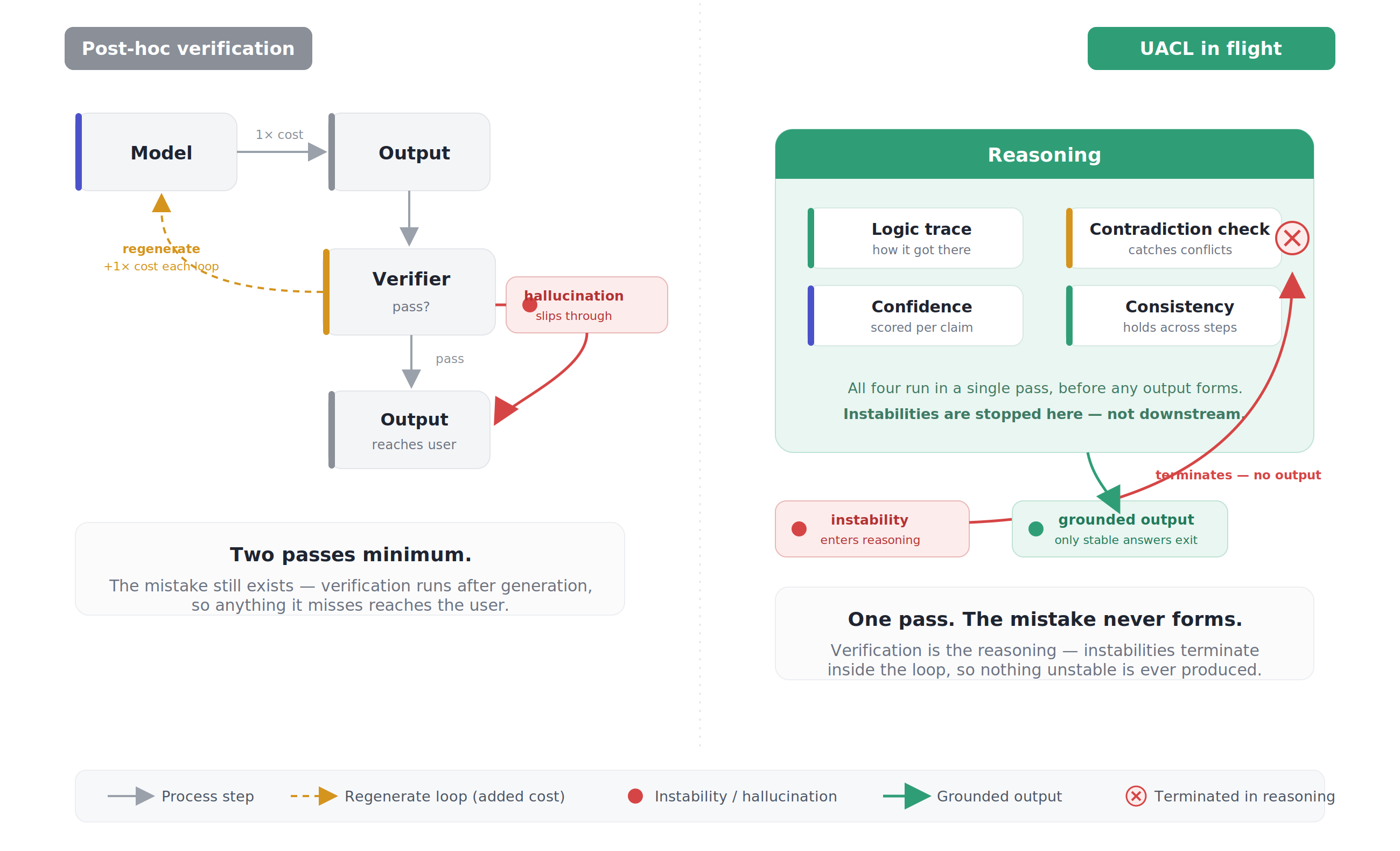
Verification after the fact means the mistake already exists. UACL governs reasoning in flight, in one pass working with your LLM, not replacing it.
It traces logic, scores confidence per claim, and checks consistency across the LLM’s layers. When those diverge, that’s a hallucination forming, caught mid-reasoning, not after. Jailbreaks are detected in the reasoning pattern, not the prompt. No classifier to bypass. Unstable reasoning terminates before an output exists.
One pass. No verification tax.
It traces logic as it reasons.
Every step is recorded and tested against the steps before it, not against the output after the fact.
It measures confidence and consistency in parallel.
When two sources disagree, UACL surfaces the conflict rather than silently guessing. It tells you both sides or says “I don’t know.” That’s what accuracy looks like in practice, regardless of which model sits downstream.
It checks retrieved evidence against the reasoning, continuously.
Current models iterate with multiple agents hoping it will find the right answer, adding tokens to your bill while the answer still isn’t correct. Our architecture guides the model intelligently to the correct answers the first time.
It interrupts before the output is generated.
Unstable reasoning terminates and UACL guides the model towards the truthful answer. Jailbreak signatures are caught in the reasoning pattern, not the prompt text. Nothing reaches the model’s output layer.
A confident wrong answer costs more than a slow one. It just bills you later.
Post-hoc verification means generating an answer, paying a second model to check it, then shipping it anyway if the check misses. UACL traces the LLM’s own logic, catches contradictions as they form, and stops hallucinations and jailbreaks before an output exists.
Your LLM provides the language. UACL provides the reasoning. Together, they produce answers you can trust.
One API call. One pass. No verification tax.
DATA SOVEREIGNTY
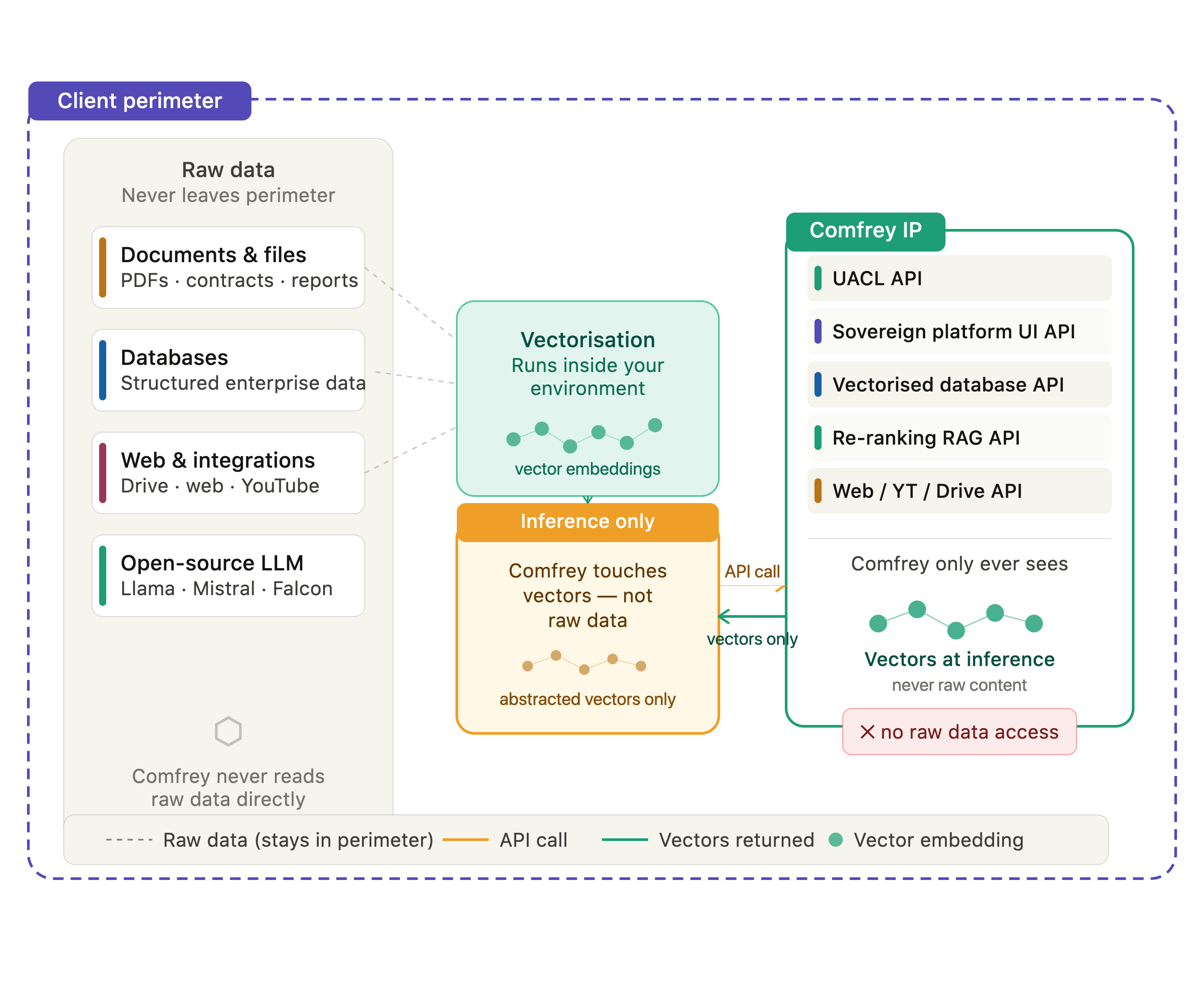
We only ever see vectors, at inference. Never your raw data.
Your documents, databases and LLM run entirely inside your perimeter. The UACL API interacts adaptively only with vectorised representations at the moment of inference. There’s no logs captured on our side, ever.
Sovereignty is the same principle as correctness: it has to be structural, not promised.
ACCURACY IS EFFICIENCY
Precision costs less than correction.
UACL is both a reasoning model and an agent. Where other platforms deploy multiple agents to chase a single answer, our algorithm navigates directly toward the grounded truth. Stop paying to generate mistakes, then paying again to find them.
The result: fewer tokens. Every time.
Have a Question?
How long does deployment actually take?
Do we have to replace our current models or infrastructure?
No. UACL is model-agnostic and runs as a layer above your existing stack. You keep your models, your infrastructure, your orchestration, and your data. UACL intercepts reasoning, governs it, and returns the answer, everything else stays as it is.
How do I reduce my enterprise AI token bill?
Most AI platforms deploy multiple agents to chase a single answer: one to retrieve, others to verify, rank and reconcile each burning tokens independently before a final response is produced. UACL replaces that with a single recursive reasoning loop that navigates directly toward the correct answer. Fewer agents means fewer tokens.
How does an agentic layer reduce the cost of enterprise AI?
How do I govern and audit AI outputs across my organisation??
AI governance in regulated industries requires more than a policy, it requires a system that can show exactly what the model accessed, what it reasoned from and what drove each answer. UACL retrieves from named sources, flags conflicts between documents and keeps human decision-makers in the loop rather than resolving ambiguity silently. Our transparent approach ensures every AI output in your sovereign deployment can be traced back to its source.
How does UACL make enterprise AI safer?
How do you stop an AI from hallucinating before it happens, not after?
Most hallucination detection waits for the mistake to appear and then flags it, but by that point, the hallucination has already been generated and your enterprise has received an answer it cannot trust. Inside UACL, we monitor two internal signals in real time during the reasoning process: confidence and consistency. When these diverge, when the model is highly certain but that certainty is unstable across reasoning steps, we have identified a pre-hallucination state and intervene before it reaches the output. The result is not a model that catches hallucinations after the fact. It is a model that was never going to produce one in the first place. As a result, UACL provides you an honest answer “I don’t know” instead of quietly and confidently providing an inaccurate response.